Beyond the Target: Guiding Students in an AI-Driven Future
In a recent talk by Rebecca Winthrop at SXSW Edu on “How to Support Resilient Youth in an AI World,” she mentioned that what worries her most when it comes to AI and our students is the underlying demotivation, with students asking questions like “AI chatbots can do everything, what am I doing here?” and “What is my role as a human being?”
With advancements in AI and the potential for one in four jobs to be transformed over the next five years, it is not unreasonable for students to question their future.
In this brave new world, students don’t need a predefined path, but a way to build direction for themselves.
The Moving Target
The standard life path and your life goal used to be: go to school, go to college, get a job that you stay in for the next 20+ years, provide for your family, and get a house with the white picket fence, the whole nine yards.
Then the target moved from a one-size-fits-all model to one that prioritized specialization.
In the early 2000s, we saw the STEM movement grow, and then the target changed to getting a STEM degree. As long as it was something in math, science, or engineering, you were in good shape and had a secure, stable job.
Then the target moved again from specialization to uncertainty and instability, where no job is safe.
Computer science was once seen as untouchable. Now computer scientists are increasingly being laid off, with unemployment rates reaching 6.1% in 2025.
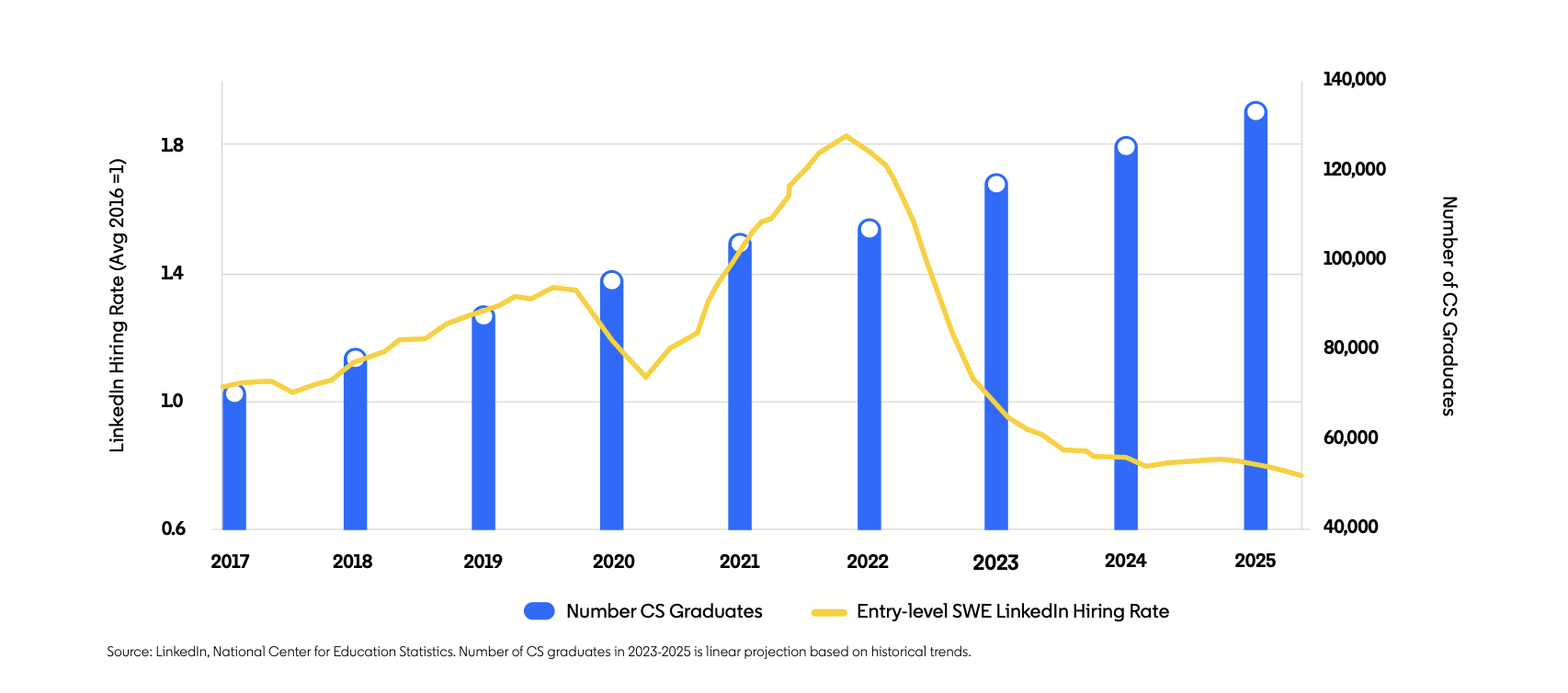
LinkedIn’s Labor Report of 2026 shows that computer science graduates hit record highs as software hiring reached record lows.
Note: SWE stands for software engineers
So where will the next target be 10 years from now in 2036?
There may not be a single target at all. Even if one emerges, it will likely shift again within a few years. What matters more is not the target, but the ability to build direction over time.
This is where purpose comes in.
The challenge is that asking students to define a single lifelong purpose rarely works. Even adults struggle to do this.
A more effective approach is to think smaller, in micro moments.
Instead of asking about their life’s purpose, ask about their purpose for the next year. The next three months. Even the next 24 hours.
The Illuminated Path

Instead of a standard life path, I like to think of the next target as an illuminated path, like one you see when holding a flashlight in the dark. It is not predetermined, and it changes depending on the direction the student is looking.
Purpose is not set in stone. It is a fluid and ever-changing entity that unfolds over time. Rather than a lifelong declaration, purpose can be thought of as a series of micro-moments, short-term directions that students can act on and adjust as they go.
The path a student follows depends on their current interests, experiences, and influences, including what they learn, who they spend time with, and the media they consume. This illuminated path is not fixed, and it shifts as students grow.
Our role as educators is not to push every student onto the same track, but to shepherd them along this changing path, helping them explore and follow the direction that aligns with their evolving purpose.
Redefining Our Purpose
AI is forcing us as humans to redefine our purpose. The world of work and learning is changing, and students will need new ways to navigate it.
Here are some predictions for the coming years:
Portfolio Careers: We will see a rise in portfolio careers, where students do not stay in a single job for their entire career. Instead, their careers will be a culmination of experiences and skill sets that build toward a larger purpose or goal.
Monetizing Your Passion: The next generation will increasingly create their own work by monetizing their passions. We have already seen this with content creators turning videos made in their dorms into full-time income streams.
Workforce Development: Even with more freedom and flexibility, many students will crave predictability. Workforce-focused education will become more important, offering curated curricula, hands-on labs, and targeted training that lead directly to meaningful jobs. Students will want learning that goes beyond what AI can provide, focusing on skills and experiences that prepare them for the real world.
The future of work and learning will not follow a single, predetermined path. Students will navigate a world of uncertainty by building their own direction, combining skills, passions, and experiences to create meaningful careers. As educators, our role is to guide them along this evolving path, helping them discover purpose in micro-moments and illuminate the steps that lead to their unique future.