AI Insights: The Digital Childhood
Roblox. Youtube. TikTok. Fortnite.
If you ask any 8–14-year-old how they like to spend their time, I guarantee one of these platforms comes up. Move aside, food pyramid- these are the real major groups of what kids are consuming these days. Digitally, I mean.
A survey by the University of South Florida asked 1,500 kids aged 11 to 13 in Florida about their smartphone use and found that over two-thirds got their first smartphone at age 10 or younger.
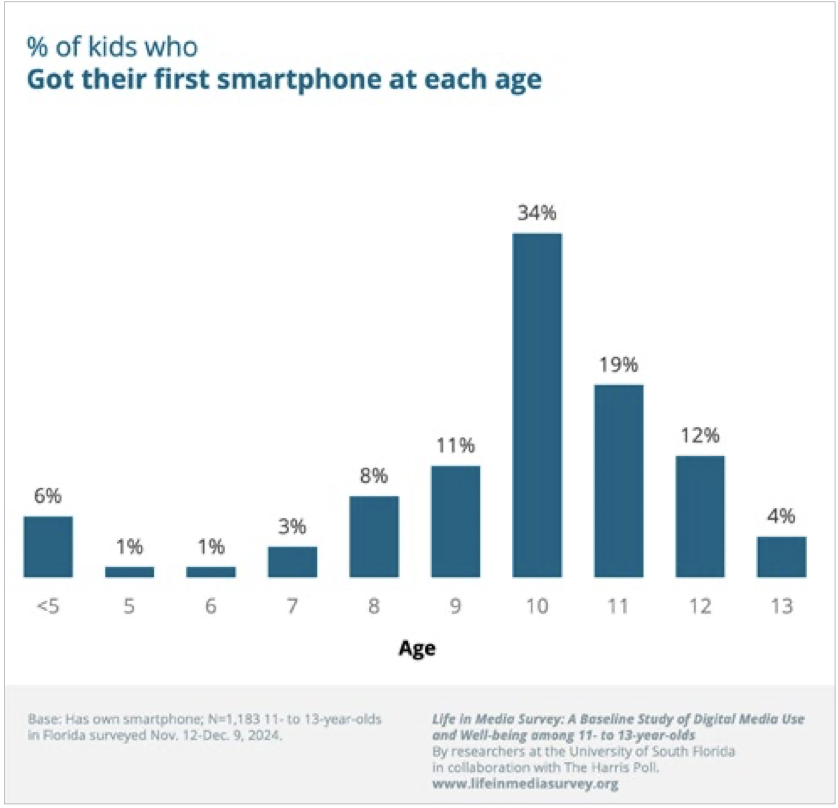
Source: 2025 Life in Media Survey
I have two nephews, and several friends that have had kids in the last couple of years. It’s made me wonder— with AI advancing so quickly, what will their childhood look like compared to what we (the millennials) experienced growing up? Even when I go to buy toys for them, they’re so different from what I had growing up. It seems like most of childhood these days happens online through a screen rather than out in the physical world.
To explore this topic further, I have collected three articles offering different perspectives on kids and the AI revolution:
One from a former lead AI developer at Google
One about a school district fully embracing AI
One about a village that has completely banned smartphone use for children
These examples show the spectrum of approaches to digital childhood, from full immersion to strict limitation. I feel like deciding how our kids grow up is a tug of war between the present and the future. We want them to be fully present in their childhood, not glued to screens, but will limiting screen time hold them back from future success in a world driven by technology, screens, and now AI?
I hope these articles provide a window into the different ways childhood is being shaped in the age of AI and help us think critically about what balance might look like for the next generation.
I’m an AI Developer. Here’s How I’m Raising My Son.
In this article, Dr. Itani talks about his four-year-old son, Omie, and how he is choosing to raise him with an eye toward the world of AI. He shares a story about having an AI actor on his screen for work when Omie casually asked, “Who is that?”—unphased, assuming it was just a new co-worker of his dad’s.
Dr. Itani emphasizes fostering critical thinking and creative flexibility as key ways to prepare students for the future. He reflects on whether he will allow his son to use ChatGPT and explains, when the time is right “I plan to show him how to fact-check the sources the AI has provided, and make sure he understands that computers often ‘learn’ the wrong thing from online sources.”
He also shares how he currently uses AI with Omie during imaginative play, using AI to create songs or images to complement the superhero scenes they act out together. The article concludes on an optimistic note, with Dr. Itani hoping the world will eventually have two kinds of creations: one that is automated and easily generated, and another painstakingly made only by humans—and therefore cherished.
What AI and the Future of Education Look Like in Westchester
In this article, education leaders and school district officials in Westchester discuss how K‑12 education is adapting to the rise of AI and preparing students for a world where technology plays a central role. The focus is on updating curriculums to keep pace with rapid changes in digital tools, including incorporating AI literacy and critical thinking into classroom learning.
One example highlights how teachers are using education-specific AI tools like Magic School, which can generate writing prompts, quizzes, or appropriately leveled reading materials. This frees up teachers to spend more time directly engaging with students, fostering critical thinking and creativity rather than getting bogged down in routine lesson planning.
The article emphasizes that it’s not just about teaching students to use AI, but helping them understand when and how to use it responsibly and thoughtfully. Overall, the piece frames AI as an inevitable part of the future of education and stresses the importance of equipping students with the tools they’ll need to thrive in a technologically advanced workforce.
A Phone-Free Childhood? One Irish Village Is Making It Happen.
In this article, the author highlights an effort in Greystones, Ireland, where families and the local community have voluntarily embraced a phone‑free approach for young children. Rather than smartphones being the default companion for kids, parents, teachers, and even local shops signed a grassroots pact encouraging families to delay giving children phones until they are older—often not until secondary school. This pact came after surveys showed significant anxiety and stress among youth tied to early phone use, and community leaders believed slowing down technology adoption could help preserve more traditional, real‑world childhood experiences.
The article explores how this voluntary agreement has shaped daily life for families who choose to participate. It isn’t a strict law, but a community commitment that encourages kids to grow up without fast access to screens and social media. Supporters argue that reducing early exposure to smartphones can help children focus on in‑person social skills, imagination, and play, while still allowing parents to find other ways to stay connected and safe without giving in to early tech dependence. Critics, however, note that phones now play a practical role in everyday life and that striking the right balance between protection and preparation is complicated.
Childhood today looks very different from what many of us experienced. Some embrace AI and screens as tools for learning and creativity, while others prioritize space for imagination and real-world engagement. There is no one right approach, but by being thoughtful and intentional, we can help kids grow up equipped for a digital future while still experiencing a meaningful, human childhood.