#28: 100,000 New Planets, Prada on the Moon & AI Weed-Killing Robots
Source: sat news
Space
NASA’s Roman Mission Preps to Unveil New Populations of Faraway Worlds
Summary: NASA's Nancy Grace Roman Space Telescope is preparing to dramatically expand our catalog of planets beyond our solar system. Scientists have confirmed nearly 6,300 exoplanets since the first discoveries in the 1990s, and Roman is expected to find roughly 100,000 more. It uses two complementary techniques: the transit method, which detects tiny dips in a star's brightness when a planet crosses in front of it, and microlensing, which uses gravity to detect how a planet briefly bends and amplifies light from a distant background star. Microlensing is the key here: it can find small, rocky planets in wide orbits that other telescopes miss entirely. Roman will focus much of its search on the galactic bulge, the dense, star-packed center of the Milky Way, where stars have different chemical compositions than the ones near Earth.
Article Link: https://www.nasa.gov/missions/roman-space-telescope/nasas-roman-mission-preps-to-unveil-new-populations-of-faraway-worlds/
Classroom Connection:
Exploring Exoplanets with Kepler: https://www.jpl.nasa.gov/edu/resources/lesson-plan/exploring-exoplanets-with-kepler/
Exoplanets in a Box: https://hackanexoplanet.esa.int/exoplanets-in-a-box/
The Roman Space Observer Game: https://roman.gsfc.nasa.gov/game.html
Submit your name and email for a boarding pass for the Roman mission!: https://my.nasa.gov/specialevents/s/send-your-name-with-nancy-roman?fbclid=IwY2xjawSfo7dleHRuA2FlbQIxMABicmlkETE3d2p3eDc3eVU5dmJqcmZoc3J0YwZhcHBfaWQQMjIyMDM5MTc4ODIwMDg5MgABHm01HcRn4KMd86gBZxiTUbI1bz_PEj1tgF454chmfD2bn_u9Fy1FjM6_MH2F_aem_YWdncwBWBv5DMtwmV5uqe9boD-rF
Robotics and AI
How Aigen transformed agricultural robotics for sustainable farming with Amazon SageMaker AI
Summary: A company called Aigen builds solar-powered autonomous robots that roll through farm fields, use computer vision to identify weeds, and remove them without any herbicide. When Aigen started, labeling each training image by hand cost $2.00 and took about 15 minutes. After switching to Amazon SageMaker and using AI foundation models to automate most of the labeling process, the cost dropped to 9 cents per image and the time fell to 41 seconds. Their experimental capacity jumped from 5 model tests per week to hundreds, and adding a new crop to the system shrank from months to weeks. It is a concrete, data-rich example students can really dig into: AI is not just the end product here, it is also what made building the product fast enough to matter.
Classroom Connection:
Robots in High-Tech Farming (Grades 3-5): https://agclassroom.org/matrix/lessons/690/
Robots in High-Tech Farming (Grades 6-8): https://agclassroom.org/matrix/lessons/693/
Farming Robot: https://shop.iastate.edu/extension/4-h/4-h/4-h-stem/4h1486.html
Space
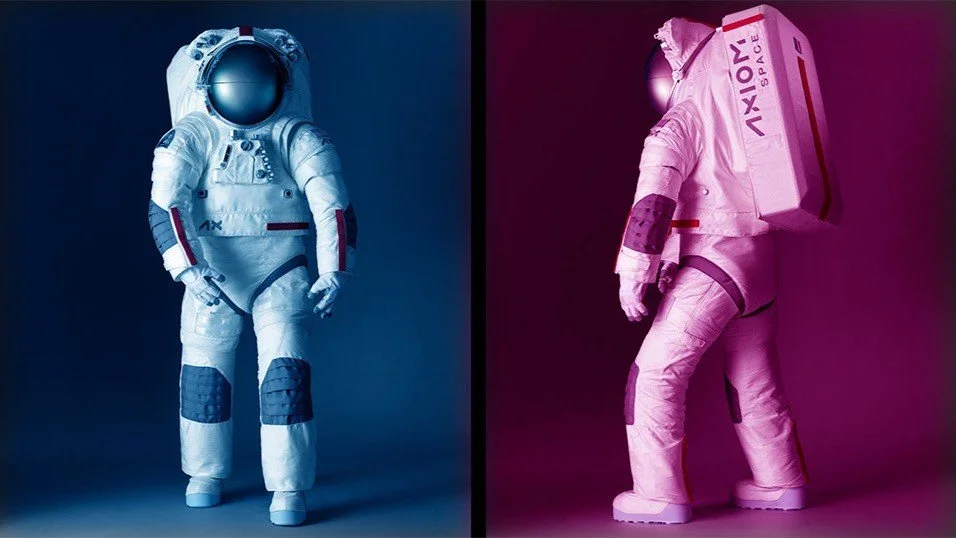
Axiom Space, Prada Unveil Inner Layer of Next-Gen Lunar Spacesuit
Summary: The next astronauts to walk on the Moon will be wearing something designed in part by one of the world's most recognized fashion houses. Axiom Space and Prada have unveiled the Liquid Cooling and Ventilation Garment, the inner layer of the spacesuit that Artemis IV crew members will wear on the lunar surface. It works by circulating cold water through tubing that runs across the astronaut's major muscle groups, absorbing body heat generated during physical work, while a separate system delivers fresh oxygen to the face and removes exhaled carbon dioxide. The garment has to keep a human safe and functional for up to eight hours in an environment where temperatures swing hundreds of degrees. Prada brought advanced 3D modeling, engineered knitting techniques, and specialized high-performance fibers that make the garment durable enough for repeated use across long missions.
Article Link: https://www.axiomspace.com/release/axiom-space-prada-unveil-inner-layer-of-next-gen-lunar-spacesuit
Classroom Connection:
Spacesuits: Heads-Up Display Activity: https://www.nasa.gov/stem-content/spacesuits-heads-up-display-activity/
GRADES K-5 DESIGN A SPACE SUIT: https://intrepidmuseum.org/resources/education/learning-library/grades-k-5-design-space-suit
Spacesuit Design: https://www.clcnwi.com/file_download/inline/00524411-2f5c-4142-a5b5-e8a867c06c74
Thanks for reading and see you next week! If you found this newsletter insightful, please share with a fellow educator.
Need support with STEM education? I’ve got you covered:
I’m studying STEM ecosystems across the U.S., sharing best practices and ideas to bring back to your community. Grab my STEM Ecosystem Insights Report: https://www.aspenholland.com/ecosystem-report
Are you an educator wanting to bring real-world STEM experiences to your students? Join my Education Partners Database ➡️ https://forms.gle/sStmf4vLm6vBonQDA
Want to activate your brand through STEM? Let’s work together to design a hands-on experience that connects your brand with students and communities. Book your call here: https://www.aspenholland.com/consultation