#29: Nature Is an Engineer: What Ducks, Roaches & the Human Body Can Teach Us
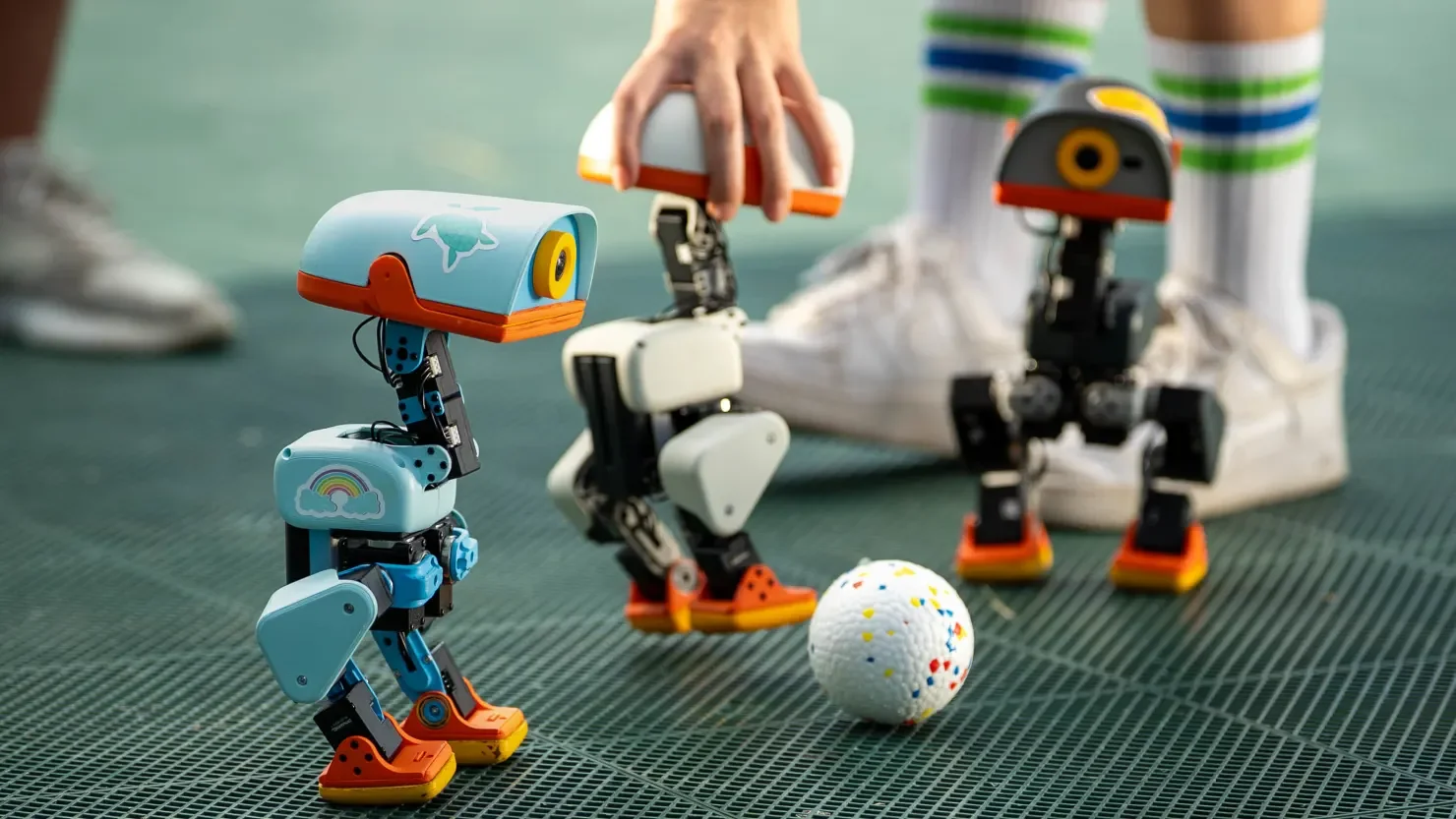
Source: Pollen Robotics
Robotics & Artificial Intelligence
"Hugging Face's new duck robot is selling fast. A Chinese chip powers it"
Summary: Meet Microduck, a 25-centimeter robot duck from Pollen Robotics, the French robotics arm of AI company Hugging Face. It can walk, sit, kick, pick things up with its beak, and get back up after a fall, using 15 motors, a camera, and motion sensors. It sold more than 10,000 units at $399 each within days, bringing in over $5 million and pushing delivery dates past Christmas. Its brain is a small chip made by Shanghai-based Rockchip, built on technology from British company ARM, which shows how many countries can contribute to one gadget. The best part for classrooms is that its software is open source, so anyone can retrain its behaviors and share what they build.
Article Link: https://www.cnbc.com/2026/09/01/hugging-faces-new-duck-robot-is-selling-fast-a-chinese-chip-powers-it.html
Classroom Connection:
AI for Oceans, where students train a machine learning model and watch it learn ( Grades 3-12): https://code.org/oceans
Train a Pose-Detection Model, where students teach an AI to recognize body movements with a webcam (Grades 6-12): https://teachablemachine.withgoogle.com/train/pose
Teleporting Duck: https://microbit.org/projects/make-it-code-it/teleporting-duck/
Bioengineering & Robotics
"Paramedic cockroaches: cyborg care when rescuers can't reach"
Summary: Researchers at the University of Queensland have turned giant burrowing cockroaches into "Paraborgs," cyborg insects that can crawl through collapsed buildings to reach trapped survivors. Each cockroach wears a tiny backpack with navigation electronics and either a camera or a miniature medical injector. Operators steer them with a gaming controller. In tests they hit their target 95% of the time from within 15 centimeters and completed the full find-and-treat mission in 72% of trials. The insects live normally once the backpack comes off, and the team hopes swarms of rescue insects could be in use within 5 to 10 years.
Article Link: https://news.uq.edu.au/2026-08-paramedic-cockroaches-cyborg-care-when-rescuers-cant-reach
Classroom Connection:
Robotic Search and Rescue Challenge, where teams program a robotic ball to handle a disaster scenario (Grades 5-8): https://www.nasa.gov/stem-content/robotic-search-and-rescue-challenge/
Copycat Engineers, where students design prototypes inspired by animals and plants (TeachEngineering, Grades 6-8): https://www.teachengineering.org/lessons/view/cub_lifescience_lesson03
Wirelessly Control a Cyborg Cockroach, a neuroengineering lab that requires the RoboRoach kit (Grades 9-12): https://backyardbrains.com/pages/experiment-wirelessly-control-a-cyborg-cockroach (Note: Curious to see if anyone has tried this, not sure if I'd be able to handle this haha 😬🫣)
How To Make a Bristlebot (K-6): https://www.makerspaces.com/wp-content/uploads/2018/08/How-To-Make-A-Bristlebot-Ebook.pdf
Biomedical Engineering
"The SoftFoot Pro: an anthropomorphic and adaptive soft articulated prosthetic foot"
Summary: Most prosthetic feet have a flat, stiff carbon fiber sole, which makes rocks, slopes, and uneven ground hard to walk on and raises the risk of falling. Engineers at the Italian Institute of Technology built the SoftFoot Pro, a foot with a flexible sole that bends around obstacles the way a real foot does. It has no motors, weighs about 450 grams, and supports up to 100 kilograms. In tests with two prosthetic users, it reduced strain on their knees and hips and made their walking more even on both flat and rough ground. It's a great example of engineers copying the human body to solve a human problem.
Article Link: https://www.nature.com/articles/s41467-025-68194-2
Classroom Connection:
The Power in Prosthetics, where students build a prosthetic hand that can grab everyday objects (Grades 3-5): https://www.teachengineering.org/activities/view/uof-2712-prosthetics-power-engineering-design-activity
Prosthetic Party, where teams build and test lower-leg prosthetics from ordinary materials (Grades 6-8): https://www.teachengineering.org/activities/view/cub_biomed_lesson01_activity1
Design the Ultimate Climbing Shoe: https://www.invent.org/blog/stem-activity/shoe-design
Thanks for reading and see you next week! If you found this newsletter insightful, please share with a fellow educator.
Need support with STEM education? I’ve got you covered:
I’m studying STEM ecosystems across the U.S., sharing best practices and ideas to bring back to your community. Grab my STEM Ecosystem Insights Report: https://www.aspenholland.com/ecosystem-report
Are you a STEM after-school program leader? Join the STEM Leaders Lab — my monthly membership where we master the operational systems to build and sustain a thriving K–12 STEM program: https://stemmadesimple.substack.com
Want to activate your brand through STEM? Let’s work together to design a hands-on experience that connects your brand with students and communities. Book your call here: https://www.aspenholland.com/consultation