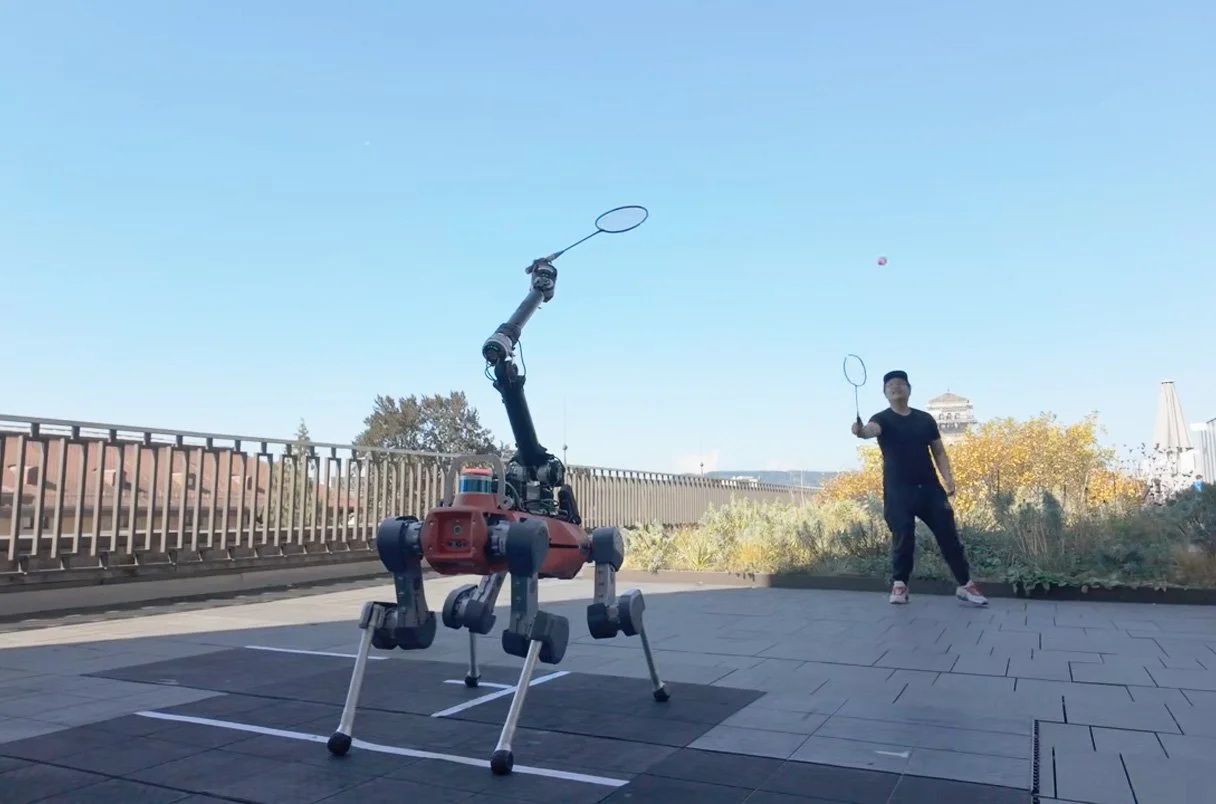
YUNTAO MA/ROBOTIC SYSTEMS LAB/ETH ZÜRICH
Robotics & Artificial Intelligence
"Watch a robot play badminton against human players"
Summary: Racket sports like badminton are some of the hardest for a robot to learn, because they demand complex footwork, excellent hand-eye coordination, and rapid decision-making. Researchers at ETH Zürich, reporting in the journal Science Robotics, built a four-legged robot with a quick-moving racket arm that tracks a shuttlecock midair and moves across the court to send it back to a human player. They trained the robot to move its camera the way a human player shifts their gaze, looking up to follow an incoming shuttlecock and then back down to line up its swing. It also learned to return to the center of the court after each hit, the same way a human player gets ready for the next shot. Against amateur human opponents, the robot missed some shots but eventually hit a streak of 10 successful shots in a single rally. Science reports that the robot is still a beginner and won't be beating badminton pros anytime soon, but it shows robots can play a full sport against people on their own.
Article Link: https://www.science.org/content/article/watch-robot-play-badminton-against-human-players
Classroom Connection:
NASA - National Aeronautics and Space Administration Robotic Arm Challenge: Build a Robotic Arm from Household Items: https://www.nasa.gov/stem-content/robotic-arm-challenge/
Reaction Game: Build Foil Switches and Code a Reaction Test: https://microbit.org/projects/make-it-code-it/reaction-game/
VEX Robotics Robot Soccer: https://education.vex.com/stemlabs/iq/robot-soccer
Materials Science & Space Exploration
"New Material Could Help NASA Melt Moon Rocks, Harness Lunar Resources
Summary: NASA wants future astronauts to "live off the land" by melting Moon rocks to pull out metals for building and oxygen for fuel and life support. The challenge is that molten Moon dust is very corrosive and quickly eats through common heat-resistant materials. Dr. Kevin Yu, a former NASA graduate fellow who is now a technologist at NASA's Jet Propulsion Laboratory, and Dr. Jamesa Stokes, a materials research engineer at NASA Glenn Research Center in Cleveland, discovered a new material while heating simulated lunar dust with scandium oxide in a red-hot furnace. It did not match any of the more than 1 million substances in their X-ray analysis database, and their tests showed that molten Moon dirt does not corrode it too quickly. The powder goes in pink, "almost like strawberry milk," Dr. Yu says, and turns light beige or tan when the reaction works. It could be used for pipes or basins that hold molten lunar dust, and as a lighter, better-insulating coating for jet engine parts.
Article Link: https://www.nasa.gov/general/new-material-melt-moon-rocks/
Classroom Connection:
Digging on the Moon: Build a Drill Bot and Test It on Icy Regolith (Grades 6-12): https://www.nasa.gov/stem-content/digging-on-the-moon-hands-on-activity/
You Can't Take It All With You: Make Building Materials from Local Resources (Grades K-12): https://www.nasa.gov/stem-content/you-cant-take-it-all-with-you-series
Chemical Mystery: https://girlstart.org/wp-content/uploads/2019/12/11.-Chemical-Mystery.pdf
Chemistry & Sustainable Materials
"H&M wants to make clothing from CO2 using this startup's tech"
Summary: Most of the cellulose used to make fabrics like lyocell and viscose comes from trees, including plantations and virgin rainforests. Rubi, a startup led by co-founder and CEO Neeka Mashouf, makes that same cellulose from captured carbon dioxide instead. Its process uses a "cascade" of enzymes floating in water, which Mashouf describes as "basically taking the machinery of biology outside of the cell," and white cellulose forms in the reactor within a few minutes of adding CO2. The company has used AI and machine learning to make its enzymes work better and last longer, and its reactors fit inside modules about the size of a shipping container. TechCrunch's Tim De Chant reports that Rubi raised $7.5 million, with H&M Group among the investors, to build a demonstration system designed to produce tens of tons of material. The material has already been tested with 15 pilot partners, including H&M, Patagonia, and Walmart.
Article Link: https://techcrunch.com/2026/03/17/hm-wants-to-make-clothing-from-co2-using-this-startups-tech
Classroom Connection:
What Do Enzymes in Pineapple Juice Do to Milk? (Science Buddies, Grade 5): https://www.sciencebuddies.org/teacher-resources/lesson-plans/enzyme-milk-curdling
Sustainable Sneakers: https://www.scitech.org.au/challenge/sustainable-sneakers/
Fast Fashion Curriculum Activity: https://stem-gals.org/fashion-curriculum-activity
Thanks for reading and see you next week! If you found this newsletter insightful, please share with a fellow educator.
Need support with STEM education? I’ve got you covered:
I’m studying STEM ecosystems across the U.S., sharing best practices and ideas to bring back to your community. Grab my FREE STEM Ecosystem Insights Report here: https://www.aspenholland.com/ecosystem-report
Want to activate your brand through STEM? Let’s work together to design a hands-on experience that connects your brand with students and communities. Book your call here: https://www.aspenholland.com/consultation